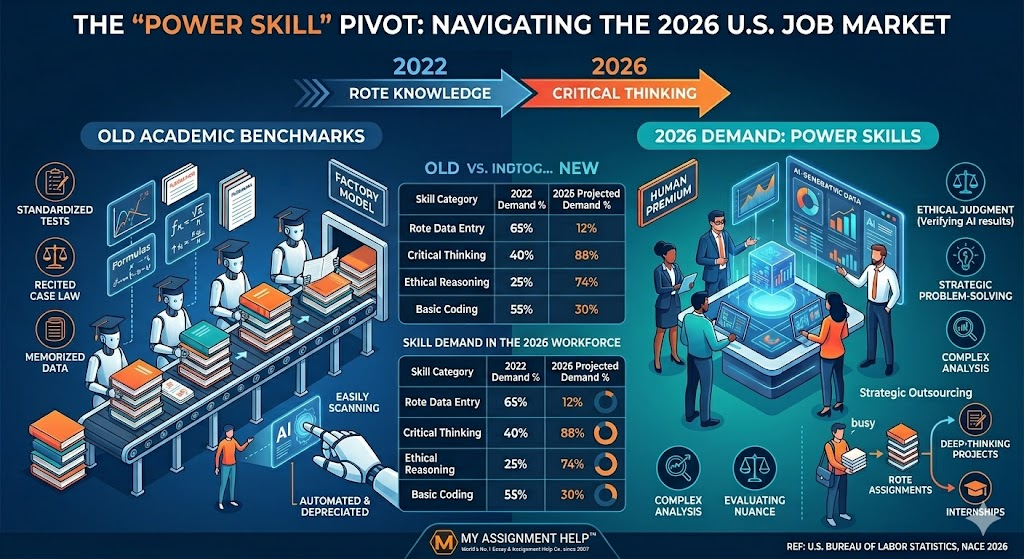
The American workforce is currently navigating a seismic shift. As we move through 2026, the traditional benchmarks of academic success—memorizing formulas, reciting case law, and mastering standardized testing—have been eclipsed. In an era where Generative AI can synthesize vast amounts of data in seconds, “knowing” information is no longer a competitive advantage. Instead, “processing” and “evaluating” that information has become the ultimate currency.
This transition, known as the “Power Skill” Pivot, represents a fundamental change in what U.S. employers seek. According to recent labor market analyses, 92% of hiring managers in the STEM and Business sectors now prioritize “durable skills”—critical thinking, ethical judgment, and complex problem-solving—over technical rote knowledge.
The Death of Rote Memorization in the AI Era
For decades, the U.S. education system was built on a factory model: input data, store it, and retrieve it for an exam. However, the 2026 job market has no room for human databases. With the integration of advanced neural networks in every workplace from Silicon Valley to Wall Street, the mechanical aspects of “work” are automated.
What remains is the “Human Premium.” Employers are looking for professionals who can look at an AI-generated report and spot the ethical hallucinations, the logical fallacies, or the lack of cultural nuance. This requires a level of deep analysis that isn’t taught through flashcards. Students are increasingly pivoting their focus toward these high-level cognitive tasks. To manage this transition, many are restructuring their academic schedules; for instance, a doctoral candidate might seek specialized dissertation help to handle the rigorous data structuring and literature synthesis required to meet modern 2026 TEQSA-aligned standards, allowing them to focus on the original contribution of their research.
Why Critical Thinking is the “New Tech”
In 2026, critical thinking is not just a soft skill; it is the most critical technical skill. A report by the National Association of Colleges and Employers (NACE) indicates that while proficiency in tools like SQL or Python remains important, the ability to ask the right questions of those tools is what determines salary growth.
The “STEM Talent Gap” of 2026 isn’t just about a lack of coders; it’s about a lack of strategic thinkers. Companies are no longer hiring based on what you can do on a chalkboard, but on how you can navigate a “Post-Truth” information environment.
The Strategic Outsourcing of Routine Tasks
Modern American students are acting more like Project Managers than traditional pupils. They understand that their time is a finite resource. To cultivate “Power Skills,” they must offload the “Rote” tasks that do not contribute to their long-term cognitive growth.
This is where the shift in academic assistance has occurred. Rather than struggling with repetitive, low-impact busywork, savvy students often choose to pay someone to do my homework for foundational assignments. This isn’t about avoiding work; it’s about strategic allocation of effort. By outsourcing routine calculations or basic formatting tasks, students reclaim 15–20 hours a week to dedicate to internships, leadership roles, and the deep-thinking projects that actually impress 2026 recruiters.
See also: Crypto and Digital Identity
Data Insights: The 2026 Employment Landscape
| Skill Category | 2022 Demand % | 2026 Projected Demand % |
| Rote Data Entry | 65% | 12% |
| Critical Thinking | 40% | 88% |
| Ethical Reasoning | 25% | 74% |
| Basic Coding | 55% | 30% (AI-Assisted) |
Source: 2026 Future of Work Initiative / U.S. Bureau of Labor Statistics
Key Takeaways
- The AI Equilibrium: AI handles the “what”; humans must handle the “why” and “how.”
- Durable Skills: Critical thinking and ethical judgment are the highest-paid skills in 2026.
- Time Management: Successful students are outsourcing rote tasks to focus on “Power Skill” acquisition.
- Employer Expectations: Recruiters are looking for “Human Premium” traits that AI cannot replicate.
FAQ
Q: Is rote memorization completely useless in 2026?
A: Not entirely. You still need a foundational knowledge base to think critically. However, it is no longer the end goal of education; it is merely the starting point.
Q: How do employers test for critical thinking during interviews?
A: Many U.S. firms now use “Simulated Environment Testing” where candidates must solve a real-world crisis in real-time, often with conflicting data points provided by an AI.
Q: Does using academic support services hurt my learning?
A: If used strategically to manage “rote” load, it can actually enhance learning by allowing you to focus on the complex, higher-order aspects of your degree that employers actually care about.
About the Author
Lachlan Miller is a Senior Academic Strategist at MyAssignmentHelp. With over 15 years of experience in the EdTech sector and a focus on the 2026 Australian and U.S. educational shifts, Lachlan specializes in helping students transition from technical learners to strategic leaders. He has authored over 200 articles on academic integrity, STEM career paths, and the integration of AI in higher education.
References
- U.S. Department of Labor: 2026 Workforce Trends Report.
- NACE: Job Outlook 2026 – The Rise of the Human Premium.
- Harvard Business Review: Why AI makes Critical Thinking more, not less, important (March 2026).
- TEQSA 2026 Framework on Academic Integrity and Skill Acquisition.