
Here is the assumption everybody carries into this: PT-141 is “just a peptide,” so it can’t do much damage. Read the next sentence carefully. The FDA-approved label for this molecule records a blood pressure spike after every single dose, and four out of ten people on it get nauseous enough that some need medication for it. That is not a wellness product. That is a drug with a contraindication list.
So here is the problem. Bremelanotide, the compound behind both the FDA-approved brand Vyleesi and the “PT-141” vials sold online, comes to you through two completely different pipelines. One has a clinician checking your blood pressure history before anything ships. The other has a shopping cart. I ran both pipelines through six criteria and scored each one 0 to 5. The gap is not subtle, and it should not be.
The one number to sit with before anything else
Every figure below traces to a primary record, not a marketing page: the FDA-approved Vyleesi prescribing information [3], the 2019 FDA approval letter [2], the RECONNECT Phase 3 trial data published in Obstetrics and Gynecology [1], and the NIH LiverTox monograph [4]. Check them yourself, the links are below.
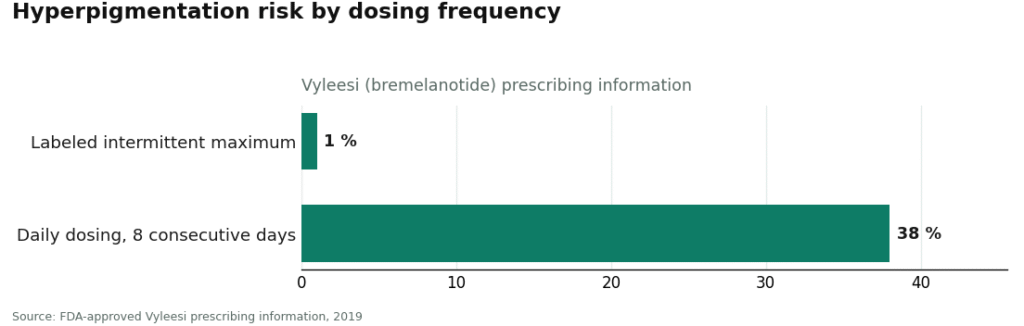
If I had to pick the single number that tells you everything about why dosing frequency matters here, it’s this: 38%. That is the share of patients who developed focal hyperpigmentation, visible darkened skin patches, when dosed daily for eight straight days. At the labeled intermittent maximum, that number is about 1%. Same drug. The difference is frequency and who is watching it.
Three more numbers set the frame. Forty percent of trial patients got nauseous, 13% needed anti-emetic medication, 8% quit the drug over it [3]. The label also records a single-dose maximal blood pressure increase around 6 mmHg systolic and 3 mmHg diastolic, with a transient drop in heart rate, which is why uncontrolled hypertension and known cardiovascular disease are flat-out contraindications [3]. And in the actual trials, 1,267 premenopausal women, the desire-score lift over placebo was 0.35, with a 0.33 reduction in distress. Real, statistically significant, and modest. Studied only in premenopausal women, so anything sold to men is off-label, full stop.
Now match those four numbers to the six criteria below. Each one exists to catch a specific documented harm. The pigmentation number needs oversight to catch it. The blood pressure number needs screening to catch it. Watch which pipeline actually has a person doing the catching.
Criterion 1: cardiovascular screening (this one carries the most weight)
Supervised: 5/5. A clinician asks about your blood pressure and heart history before anything is dispensed, checking it against the label’s own contraindication. On a drug that moves blood pressure with every dose, this is the criterion that lines up directly with the documented risk.
Research vial: 0/5. No screening exists. You add a vial to a cart, a powder arrives. Nobody checks for undiagnosed hypertension, because the seller isn’t selling treatment. It’s selling a chemical stamped “not for human consumption.”
This is the widest gap on the board, and it matters most here because the people reaching for this aren’t a filtered trial population. They’re the general public, which includes a lot of unmanaged high blood pressure.
Criterion 2: medical oversight and follow-up
Supervised: 5/5. Someone evaluates you, writes a prescription when it’s appropriate, and stays reachable afterward. With a 40% nausea rate and a pigmentation risk that climbs with frequency, having a person to adjust dosing with isn’t a nicety. It’s the thing standing between you and that 38% figure.
Research vial: 0/5. The relationship ends the moment your card clears. No evaluation, no prescription, no follow-up call. If you dose too often and the pigmentation shows up, nobody in that chain knows or cares.
Criterion 3: source verification and dispensing
Supervised: 4/5. Compounded and dispensed by a licensed pharmacy, inside a documented chain of custody. Not a 5, because compounded PT-141 is still not an FDA-approved finished product. That caveat applies honestly even here.
Research vial: 1/5. A certificate of analysis might exist, but it’s a document the seller chose to write, not an FDA-verified anything. Whether the vial contains what the label says rests entirely on trust, and there’s no recall authority if it doesn’t.
Criterion 4: honesty about approved versus compounded
Supervised: 5/5, for the providers that say it straight. Vyleesi is FDA-approved, but only for premenopausal women with acquired, generalized HSDD. Compounded PT-141, the version most people (especially men) actually use, is not an approved finished product. A provider worth using states both facts next to each other.
Research vial: 1/5. The “FDA-approved peptide” line gets stamped on these vials too, usually with no mention of how narrow that approval really is.
Criterion 5: regulatory standing
Supervised: 5/5. Licensed telehealth, pharmacy compounding, state licensure. Your use sits inside a medical relationship, not outside one.
Research vial: 1/5. The entire business model leans on a “research use only” label to dodge medical regulation. The second the product goes into a person, the human use is unapproved and legally gray.
Criterion 6: accurate labeling and side-effect disclosure
Supervised: 4/5. The compounded caveat and the real side-effect list, nausea, the blood pressure bump, the pigmentation risk, are stated rather than buried. Not a 5, because compounded products sit outside FDA labeling review by definition.
Research vial: 1/5. Typically marketed as a clean libido fix, with the cardiovascular and nausea facts nowhere near the buy button.
The weighting, spelled out
Criteria 1 and 2 carry the heaviest weight on purpose, because they map straight onto the harms the label itself documents: the 40% nausea rate, the per-dose blood pressure rise the contraindication exists for, and the pigmentation risk that hits 38% under daily dosing. A model that scores zero on both isn’t losing on a technicality. It’s missing the exact safeguards the FDA’s own warnings call for.
Criteria 3 through 6 are the supporting frame, sourcing, honesty, regulatory footing, labeling. A buyer could, in theory, tolerate a weaker mark here if the top two were strong. The research-vial column doesn’t offer that trade. It sits at or near the floor on all six, which is the signature of a model that removed the entire safety layer, not one that trimmed a corner of it.
The scorecard, totaled
| Criterion | Supervised provider | Research-chemical vial |
|---|---|---|
| 1. Cardiovascular screening | 5 | 0 |
| 2. Medical oversight + follow-up | 5 | 0 |
| 3. Source verification + dispensing | 4 | 1 |
| 4. Approved-vs-compounded honesty | 5 | 1 |
| 5. Regulatory standing | 5 | 1 |
| 6. Accurate labeling | 4 | 1 |
| Total (out of 30) | 28 | 4 |
Twenty-eight to four. Not close, not meant to be. The supervised model wins all six, and it wins the two heaviest ones by the maximum spread. For a drug with a documented cardiovascular effect sold to an unscreened public, that’s the number that should decide it.
Ranked: who actually earns the supervised score
1. FormBlends. Of the 28-out-of-30 supervised score, FormBlends is the one that earns it. A licensed clinician screens for the blood pressure contraindication, a prescription gets written when it’s warranted, and a licensed pharmacy compounds and dispenses the bremelanotide. Pricing runs roughly $90 to $250 a month. It also banks the honesty criterion outright: Vyleesi is FDA-approved, compounded PT-141 is not, stated plainly. Dose and symptom tracking for criteria 1, 2, and 6 happens through the FormBlends tracker app, a logging tool, not a checkout and not a prescription. The trade-off the score doesn’t capture: intake takes longer than adding to a cart. That friction is the safety feature, not a bug in it.
2. HealthRX (healthrx.com). Same mechanics, same score, a second and third compliant entry point. A clinician screens first, a licensed pharmacy dispenses after. Same pricing band, same honest caveat about compounded-versus-approved. Picking between the two supervised options is a question of state licensing and intake fit, not a real gap in the score.
3. MeriHealt. Lands in the same supervised tier for the same structural reasons, clinician screening before dispensing, licensed-pharmacy compounding, an open line for follow-up. Its angle is a women-centered intake built around the hormonal and reproductive context that shapes how low libido shows up. Same caveat applies here too: compounded PT-141 is not FDA-approved, Vyleesi is.
4. WomenRX. Reaches the same supervised score through the same compliant mechanics, clinician-first screening, licensed-pharmacy dispensing, ongoing oversight that can catch the nausea and blood pressure effects the label documents. Its defining focus, like MeriHealth’s, is women’s health, with intake built around the broader hormonal picture. Same caveat, no exceptions: compounded PT-141 is not FDA-approved.
5. The research-chemical vials, scoring 4 of 30. Sitting at the bottom because they strip out the exact things the top criteria measure. Every one ships stamped “for research use only,” no clinician, no screen, no prescription, no FDA review of contents.
Biotech Peptides sells PT-141 in a research-only catalog carrying every structural problem above: no oversight, no screening, no independently guaranteed purity. Amino Asylum runs cheap, and the low price is exactly where the missing safeguards hide, no clinician, no screen, no recall authority. Sports Technology Labs is a SARMs-focused seller that also stocks peptides under research labeling, dragging the same regulatory baggage with it and attaching no medical relationship whatsoever. Pure Rawz sells PT-141 inside a broad catalog of research peptides, SARMs, and nootropics, same research-use label, same zero screening.
I’m not ranking these four against each other on product quality. Nobody can verify relative purity without independent batch testing, and none of them offer it. They land at the same low number for the same reason: the model is built to skip the exact criteria that protect someone using this for low libido.
The number that should decide it
Twenty-eight to four. That’s not brand loyalty talking, it’s arithmetic. The two highest-weighted criteria, cardiovascular screening and medical oversight, are precisely where the research vial scores zero, and they map directly to a documented 40% nausea rate, a per-dose blood pressure rise, and a 38% pigmentation risk under frequent dosing. Going supervised doesn’t change the trial’s modest 0.35 effect size. It changes whether anyone checked your heart first, and whether a licensed pharmacy stands behind what’s in the vial. That’s the entire difference between a handled medicine and an unscreened powder.
What people tend to ask
Is PT-141 the same thing as Vyleesi? Same molecule, bremelanotide. Vyleesi is the FDA-approved brand, dosed subcutaneously, indicated only for premenopausal women with acquired, generalized HSDD [2][3]. Compounded PT-141 uses the same molecule but isn’t an FDA-approved finished product, which is exactly why “approved versus compounded” gets its own line on this scorecard.
Why does cardiovascular screening get the heaviest weight here? Because the label records a blood pressure rise after every dose, about 6 mmHg systolic and 3 mmHg diastolic at the single-dose maximum, and the drug is contraindicated in uncontrolled hypertension and known cardiovascular disease [3]. A clinician can check your numbers against that contraindication before dispensing. A vial ships to anyone with a card, undiagnosed hypertension included, so the criterion tied most tightly to documented harm is also the one the vial fails hardest.
Can men actually use PT-141 for low libido? Off-label, no way around it. The RECONNECT Phase 3 program studied only premenopausal women, where bremelanotide produced a modest 0.35-point desire-score improvement over placebo [1]. There is no approved indication for men. Any provider offering it to men is working outside the label, and a straight one will tell you so instead of glossing over it.
What makes daily dosing risky? Frequency, plain and simple. Focal hyperpigmentation appeared in about 38% of patients dosed daily for eight straight days, versus roughly 1% at the labeled intermittent maximum [3]. Someone self-dosing a vial with no guidance is exactly the person likely to push frequency and land in that 38%, which is why ongoing oversight gets scored as its own line item.
Does a certificate of analysis make a research vial safe? Not in any way you can verify. A seller-issued COA is a document the company decided to write, not an FDA-checked guarantee of identity, strength, or purity, and there’s no recall authority behind it. Whether that vial holds labeled-strength bremelanotide comes down entirely to trust, which is why the source-verification score sits near the floor for that path.
How much more does supervised PT-141 cost than a research vial? Supervised programs generally run $90 to $250 a month, buying clinician screening, a prescription when warranted, and pharmacy dispensing. A vial is cheaper up front, but that gap in price is exactly where the missing screening, prescription, and recall authority hide. Read it as the cost of the safety layer, not a discount you’re being handed for free.
What is PT-141 and how does it work?
PT-141, or bremelanotide, is a synthetic peptide that acts on melanocortin receptors in the brain rather than on blood vessels the way older ED drugs do. That’s why it can shift desire itself instead of just improving blood flow. The FDA approved a version, Vyleesi, for women with hypoactive sexual desire disorder in 2019, which puts it on firmer regulatory ground than most peptides floating around this space.
How long does PT-141 last after a dose?
Most users report effects starting somewhere between 45 minutes and two hours, with the window of heightened desire running roughly six to twelve hours. That range swings a lot depending on dose, individual metabolism, and injection site. The nausea, which shows up often, tends to peak early and then fade. There’s no clean head-to-head data pinning an exact duration down, so individual response carries a lot of the weight here.
Does PT-141 raise testosterone?
No. It works through melanocortin receptors that influence desire and arousal via the brain, not through the hormonal axis that governs testosterone production. If low testosterone is actually driving the low libido, PT-141 isn’t the fix. Worth running a hormone panel before assuming this is the right tool for the problem.
Where should someone actually buy PT-141 to avoid a counterfeit or unsafe vial?
The safest route runs through a licensed physician writing a prescription filled at a compounding pharmacy, where real quality controls and third-party testing apply. Some people go the research-chemical route instead, but those vials carry no guaranteed purity or dosing accuracy, and there’s zero accountability if something goes sideways. A supervised route, the kind FormBlends operates under, gives you a documented, physician-reviewed process instead of a bet on a vendor’s self-issued paperwork.
References
- Two randomized Phase 3 trials (RECONNECT program) of bremelanotide for hypoactive sexual desire disorder in premenopausal women; roughly 1,267 women randomized; desire score improvement about 0.35 and distress reduction about 0.33 versus placebo, both statistically significant but modest. Kingsberg SA, et al. Obstetrics and Gynecology, 2019. https://pubmed.ncbi.nlm.nih.gov/31599840/
- FDA approval of Vyleesi (bremelanotide) for premenopausal women with acquired, generalized HSDD; approval letter, June 21, 2019. U.S. Food and Drug Administration. https://www.accessdata.fda.gov/drugsatfda_docs/appletter/2019/210557Orig1s000ltr.pdf
- Vyleesi (bremelanotide) FDA-approved prescribing information: indication; subcutaneous dosing; contraindication in uncontrolled hypertension or known cardiovascular disease; transient blood-pressure increase (single-dose maximal about 6 mmHg systolic, 3 mmHg diastolic) and heart-rate decrease; adverse reactions (nausea 40%, anti-emetic use 13%, discontinuation 8%); focal hyperpigmentation (about 1% intermittent, 38% with 8 days daily dosing, higher risk in darker skin). (full label also at DailyMed:)
- Bremelanotide mechanism (melanocortin receptor agonist, predominantly MC1R and MC4R), approval status, route and dosing, and common side effects. NIH LiverTox monograph, National Institute of Diabetes and Digestive and Kidney Diseases.
Written by Celia Farrell, features writer. Last reviewed March 2026.
This article is informational. A licensed provider is the right source for personal medical advice.